In the Netherlands you receive five ultrasound scans as standard during a normal pregnancy. All reimbursed by basic insurance, without deductible. We explain them one by one, what they show and what they are for.
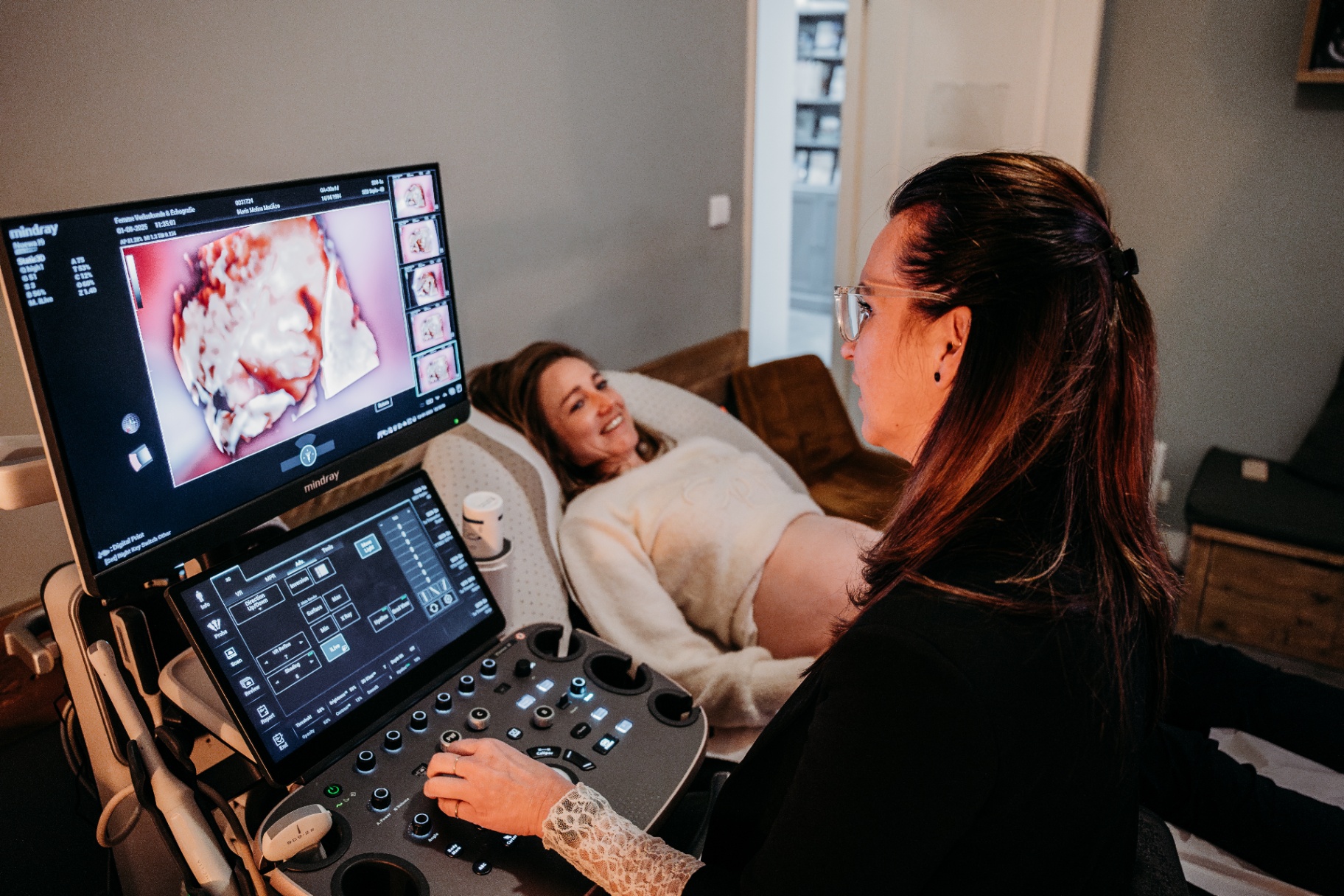
An ultrasound uses sound waves (ultrasonic, not audible) to create an image of what is happening in your abdomen. It is completely safe for you and your baby, no radiation. You will receive some gel on your stomach and the sonographer will gently move an ultrasound head over your skin. You will see your baby's image on the screen.
The very first ultrasound. Purpose: to confirm that you are pregnant, determine if there are one or more babies, and determine the due date. We measure the head-to-body length (CRL), which is the most reliable measurement point for gestational age at this stage.
For many women this is an emotional moment: for the first time you see that it is true. We take our time, your partner or a loved one can be there, and you will receive an ultrasound photo to take home.
Since 2021, the 13-week ultrasound has been part of standard Dutch pregnancy care. It is the first extensive ultrasound in which we look at your baby's development: head, trunk, arms and legs. Any special features can be identified early.
This is the most important ultrasound, also called Structural Ultrasound Examination. It lasts 30 to 45 minutes and is extensive. We look at all your baby's organs, the amount of amniotic fluid and the placenta. You can often see from this ultrasound whether it will be a boy or a girl, only if you want that.
A growth ultrasound is done if we want to check whether your baby is growing properly. For example, if there are doubts about growth, medical history, or if we feel something unusual during a check-up. Often in the third trimester. Will be reimbursed for medical indication.
Towards the end of your pregnancy we will check how your baby is lying. Head down (the most common position) makes a natural birth most likely. A breech or transverse position requires additional choices. The position ultrasound helps you to be well prepared for the birth.
Keepsake Ultrasounds, such as 3D or 4D, are extra ultrasounds that have no medical function but are intended to look at your baby. These are not reimbursed by basic insurance. If desired, Femme will refer you to a reliable ultrasound center.
Unlike many other practices, we do everything standard ultrasounds themselves, in our own practice on Boekhorststraat in The Hague. No additional appointments at another address. Our sonographers Helia, Shanice, Karen and Judith are certified and affiliated with the professional association BEN (Professional Association of Sonographers Netherlands). We work with modern equipment and take our time with each ultrasound.
An ultrasound at Femme takes 20 to 30 minutes (the 20-week ultrasound is longer). You lie on an examination couch, get some gel on your stomach and the sonographer calmly moves the ultrasound head. We explain what we see, which helps you understand what's happening on the screen. Your partner or a loved one can be there. Of course you take a photo home with you.
The five standard ultrasound scans above are 100% reimbursed by basic insurance, without affecting your deductible. Legally, these are care ultrasounds, not intended for 'looking at your baby' but for medical use. Keepsake Ultrasound scans and additional ultrasound scans without medical indication are available upon request at a surcharge.
Register and plan your ultrasound scan with us.